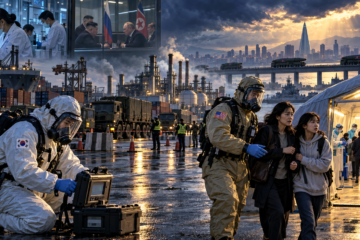

What happens when the world’s most powerful nuclear arsenal blinks in the face of a nuclear strike? In a recent Atlantic Council “Guardian Tiger” exercise, the United States faced precisely this dilemma. North Korea used a low-yield tactical nuclear weapon against South Korean forces, and Washington chose not to respond with its own nuclear arsenal.
The simulated conflict ended without regime change in Pyongyang, allowing Kim Jong Un to claim a political victory. While avoiding nuclear escalation may seem prudent, such an outcome could deal a lasting blow to the credibility of America’s extended deterrence in East Asia.
The Guardian Tiger scenario should not be dismissed as an academic exercise. It reveals a critical vulnerability in the psychological foundation of deterrence: the perception among adversaries and allies of American willingness to use nuclear weapons in defense of its partners. If allies conclude that Washington will not cross the nuclear threshold even after a nuclear attack, they may question the value of the nuclear umbrella. Adversaries, meanwhile, may learn that nuclear coercion, carefully calibrated, can succeed.
In the simulation, North Korea escalated to a tactical nuclear strike against a South Korean Navy destroyer in the East Sea (Guardian Tiger I) and later against the Chinhae naval base (Guardian Tiger II), home to the Republic of Korea Navy’s Submarine Force Command and occasionally used for allied submarine visits. According to the report, American leaders debated nuclear retaliation but settled on conventional “pulsed” strikes.
In a real-world scenario, such strikes could plausibly involve precision-guided munitions from long-range bombers like the B1-B and Tomahawk cruise missiles launched from Arleigh Burke-class destroyers, aimed at targets such as missile transporter-erector launchers, hardened artillery positions along the DMZ, and command-and-control facilities near Pyongyang. In the exercise, the US stopped short of regime change, seeking to avoid further nuclear escalation and prevent a direct war with China—a decision that would have allowed Pyongyang to absorb the damage, count the survival of its regime as a strategic win, and enter negotiations from a stronger position.
Extended deterrence depends on more than military capability. It is rooted in the belief, shared by allies and adversaries alike, that the United States is willing to defend its partners by all means necessary, including nuclear weapons. An American failure to respond in kind to North Korean nuclear use would plant seeds of doubt. Japanese and South Korean leaders could begin to question whether Washington would truly “trade Los Angeles for Tokyo or Seoul” if the stakes involved limited nuclear use rather than an existential threat to the United States.
That doubt could trigger cascading effects. Calls in Seoul’s National Assembly for indigenous nuclear weapons, expanded production of the Hyunmoo‑4 ballistic missile, and pressure on Tokyo to more seriously pursue nuclear sharing arrangements have already entered the political debate.
This concern is amplified by North Korea’s 2022 nuclear weapons law, which openly authorizes preemptive nuclear strikes in scenarios ranging from an imminent attack on leadership to undefined overwhelming crisis situations. Analysts note that the law’s language effectively lowers the threshold for nuclear use, implying tactical employment to repel invasion and seize the initiative in war. Rather than viewing nuclear use as a desperate last resort, Pyongyang now appears willing to employ such weapons early. For example, a low‑yield detonation against South Korean or American forward-deployed forces to shock Washington and Seoul into political concessions.
The challenge grows sharper in the event of a dual contingency: simultaneous crises on the Korean Peninsula and in the Taiwan Strait. Guardian Tiger II simulated such a scenario, with China launching a multi-domain assault on Taiwan while North Korea escalated on the peninsula. In such a real-world situation, US Indo-Pacific Command could be forced to divert the USS Ronald Reagan Carrier Strike Group from Yokosuka to the waters east of Taiwan, deploy B‑52H bombers to deter Chinese operations, and even consider repositioning some Terminal High Altitude Area Defense and Patriot missile defense batteries from South Korea to protect American assets in Okinawa and Guam.
Such shifts illustrate how a stretched American posture could reduce missile interception capacity on the peninsula and temporarily remove some nuclear-capable platforms from immediate Korean defense. North Korea could calculate that Washington, already balancing a larger confrontation with China, would avoid nuclear escalation in Korea to conserve resources and limit the risk of an all-out US-China war.
The political and strategic consequences would ripple across the region. In Seoul, public and elite opinion could shift sharply toward developing an independent nuclear arsenal—something 71 percent of South Koreans already support. South Korea’s nuclear latency, widely assessed by proliferation experts, suggests it could potentially produce a weapon in as little as 6 months if political consensus formed.
In Tokyo, the debate over counterstrike capabilities, missile defense expansion, and potential nuclear sharing with the United States would intensify, potentially accelerating deployment of Tomahawk missiles and further integration of F‑35A fighters, which, in the US fleet, are being certified for B61‑12 nuclear bombs, into allied defense planning. Beijing, meanwhile, could seize the opportunity to position itself as a stabilizing broker, offering to mediate between Seoul and Pyongyang while shielding the latter from full international accountability, further eroding American influence.
Avoiding nuclear escalation in a limited-strike scenario is understandable, but Washington cannot afford such a decision to be interpreted as weakness. Strengthening deterrence credibility in Northeast Asia will require more than declaratory statements. Clear and credible red lines for nuclear use must be communicated both publicly and privately. Integrated nuclear-conventional planning with allies should ensure that flexible response options, from proportionate nuclear strikes to overwhelming conventional retaliation, are executable on short notice. Contingency planning must explicitly account for simultaneous conflicts in Korea and Taiwan, with pre-positioned munitions, dispersed basing arrangements for nuclear-capable aircraft, and rotational deployments of dual-capable ships and submarines to maintain strategic presence even under force diversion.
Equally important is sustained alliance signaling. These include high-visibility joint exercises like the US-ROK Freedom Shield exercises, regular port visits by nuclear-capable submarines, and trilateral missile tracking drills with Japan. These measures reassure allies, complicate adversary calculations, and demonstrate that any nuclear use will incur unacceptable costs.
The Guardian Tiger exercises are valuable not because they predict the future, but because they reveal how quickly deterrence can fray in the fog of crisis. A single decision to refrain from nuclear retaliation, however understandable at the time, could reverberate for decades and reshape the strategic balance in East Asia. In the nuclear age, preserving deterrence means guarding against both uncontrolled escalation and the perceptions of hesitation that could invite it.
Dr. Ju Hyung Kim, President of the Security Management Institute, a defense think tank affiliated with the South Korean National Assembly, is currently adapting his doctoral dissertation, “Japan’s Security Contribution to South Korea, 1950 to 2023,” into a book.


About the Author

Ju Hyung Kim
Dr. Ju Hyung Kim currently serves as a President at the Security Management Institute, in the South Korean National Assembly. He holds a doctoral degree in international relations from the National Graduate Institute for Policy Studies (GRIPS) in Japan, a master’s degree in conflict management from the Johns Hopkins University School of Advanced International Studies (SAIS), and a degree in public policy from Seoul National University’s Graduate School of Public Administration (GSPA).