
Published: May 18, 2026 (Originally written in April 2026)
The failure of the U.S.-Iran negotiations that took place in Pakistan marks a decisive inflection point in the current Middle Eastern security course. This is not a diplomatic setback; it is the transition from a fragile de-escalation phase into a more volatile period defined by coercive pressure, military signaling, and elevated risk of miscalculation. This risk is driven by the threat Iran continues to pose to freedom of navigation in the Strait of Hormuz and by its remaining ballistic capabilities, which allow it to erratically target neighboring Arab states and regional U.S. allies.
Furthermore, the announcement of a U.S.-led maritime blockade over Iranian ports fundamentally alters the operational and strategic landscape aimed at confining the Iranian threat. The main question now is no longer whether tensions will rise, they already have, but whether the current trajectory leads toward controlled escalation, negotiated recalibration, or systemic full-scale conflict.
Structural Drivers of Escalation
At the core of the U.S.-Iran negotiations lies a set of structural but irreconcilable objectives. The U.S. continues to frame its demands around three pillars: curtailment of Iran’s nuclear development program, limitations on ballistic missile capabilities development, and the rollback of Iran’s regional proxy networks. Iran, on the opposite side, views these elements as essential to regime survival and sovereign deterrence. Accordingly, this is not a negotiation gap; it is a strategic contradiction.
Iran’s nuclear posture has evolved from a bargaining chip into a core pillar of the Iran’s Islamic Revolutionary Guard Corps’ (IRGC) and the regime’s survival. Any perceived concession risks undermining internal legitimacy and external deterrence credibility. Accordingly, ongoing diplomatic negotiations are performative rather than transformative, thus aimed at managing escalation rather than resolving underlying disputes. Additionally, the U.S. decision to impose a maritime blockade represents a calibrated escalation designed to exert economic and psychological pressure without the need to immediately resort back to kinetic operations. However, the strategic implications are profound.
Iran’s economy relies mainly on maritime oil exports. A blockade directly targets this vulnerability, threatening revenue streams, which then impacts the domestic stability, in addition to regional influence operations funded through such revenues. From Tehran’s perspective, failure to respond would signal weakness not only to the U.S. but also to its network of non-state groups across the region. This creates a classic escalation dilemma for Iran. On one hand, not responding risks strategic erosion of the IRGC and the current regime’s image. On the other hand, the response risks triggering military confrontation, which Iran cannot withstand. In such conditions, even any Iranian action such as harassment of commercial shipping, or proxy attacks carry a high probability of escalation.
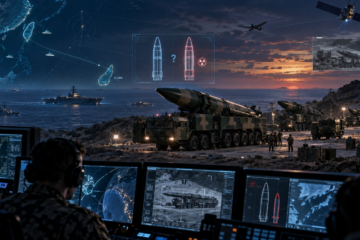
Another key driver for the escalation is the pre-positioned military capabilities. Unlike previous crises, the current environment is characterized by pre-positioned military assets and operational readiness on both sides. U.S. naval, air, and ground forces in the Middle East are already configured for rapid response operations, while Iran’s IRGC maintains asymmetric capabilities are carefully tailored for maritime disruption, drone attacks, ballistic missile launches, and regional proxy warfare.
Regional Spillover Risks
The Strait of Hormuz remains the most critical geographic variable in this confrontational equation given that one-fifth of global oil trade passes through this narrow waterway. Iran has long signaled its capability and strategic intent to disrupt traffic through asymmetric means, including naval mines, drones, and anti-ship missiles. While full closure remains unlikely due to the overwhelming U.S. response it would provoke, disruption has already been taking place via targeted attacks on passing vessels, which is more than enough to deter commercial liners. Even limited interference could generate outsized economic and political effects, particularly for energy-dependent economies. All that said, the Houthis in Yemen remain on standby mode to disrupt the maritime flow via resumption of attacks on vessels passing via Bab-el Mandeb to and from the Red Sea.
Iran’s strategic depth lies not in conventional military parity but in its network of regional proxies. Groups aligned with Tehran, including those in Iraq, Syria, Lebanon, and Yemen, provide Iran with operational flexibility. Given Israel’s successful campaign in Lebanon against Hezbollah as well as the Iran-backed Iraqi militias preoccupied with the deterrence posed by the U.S. forces, the Houthis in Yemen remain the final card for Tehran. Intensified maritime threats from Houthi forces in the Red Sea are likely to reemerge at any moment. This allows Iran to impose costs on U.S. and allied interests without triggering immediate large-scale retaliation. However, the cumulative effect of a multi-chokepoint pressure strategy could compel a broader and internationally supported response.
Strategic Calculus: War vs. Controlled Escalation
Some believe that neither the U.S. nor Iran appears to seek full-scale war given that the costs (military, economic, and political) would be immense and unpredictable. For the U.S., a major conflict with Iran would disrupt global energy markets, divert resources from strategic competition with China, and risk regional destabilization affecting key allies in the Gulf Corporation Council (GCC). For Iran, a continuation of a direct war would expose critical infrastructure to sustained strikes and threaten regime survivability.
The most probable scenario over the next 2–3 weeks is a phase of controlled escalation characterized by maritime harassment incidents in the Gulf, limited proxy attacks, and intensified rhetoric and signaling. This scenario allows both sides to demonstrate resolve while avoiding irreversible steps toward war. However, it is susceptible to disruption by unforeseen incidents at any moment.
An increasingly possible scenario would be one that involves targeted military actions, such as U.S. strikes on IRGC assets or critical infrastructure vs. Iranian retaliatory indiscriminate strikes on U.S. regional allies. Such exchanges would likely be calibrated to avoid full-scale war but could easily escalate if casualties or strategic assets are impacted.
Lastly, a less likely but still possible scenario is the return to productive negotiations, driven by economic pressures including oil market volatility, as well as diplomatic intervention by third parties, including the Gulf states, China, or European actors.
The highest-impact and most consequential scenarios involve a rapid escalation into full-scale conflict, potentially triggered by Iran’s full refusal to give up on its nuclear program or ballistic missile development program. Other triggers for a full-scale conflict would include any major incident in the Strait of Hormuz, high-casualty attacks on U.S. forces, or a direct confrontation between U.S. and Iranian military assets. Such a conflict would likely expand beyond bilateral engagement, drawing in regional actors and severely disrupting global economic systems.
Key Indicators to Watch
Several indicators are going to be crucial in assessing the trajectory of the ongoing conflict. This includes maritime activity where increased Iranian harassment of shipping continues to take place. Proxy operations are also a critical indicator where the frequency and intensity of proxy attacks, and the Red Sea specifically start to rise. Finally, force posture changes remain one of the key indicators, as they are mostly based on advanced intelligence assessments, which are not available to the public or markets. That said, deployment of additional U.S. and allied assets to the region remains the clearest indicator of how the situation will move forward and provides early signs of shifts from controlled escalation to broader conflict.
For defense strategists, the imperative is clear: preparing for escalation, planning for contingencies across multiple theaters, and achieving consensus that in the current environment, the most dangerous outcomes are not those that are intended but those unintended.
Dr. Mohamed ELDoh is a business development and consulting professional in the defense and security sector. Mohamed holds a Doctorate degree from Grenoble École de Management – France, an MBA from the EU Business School- Spain, and an Advanced Certificate in Counterterrorism Studies from the University of St Andrews, UK. He regularly authors articles addressing defense cooperation, counterterrorism, geopolitics, and emerging security threats in the Middle East and Africa. The views of the author are his own.



About the Author

Mohamed El Doh
Mohamed El Doh is a business development and consulting professional in the defense and security sector. Mohamed holds a doctorate degree from Grenoble École de Management, France, an MBA from the European Union Business School, Spain, and an Advanced Certificate in Counterterrorism Studies from the University of St Andrews, UK.