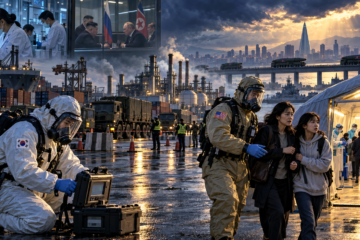

Ukraine did not just resist invasion; it shattered Western assumptions. In the weeks leading up to Russia’s 2022 invasion, the dominant view across Europe and the United States was that Ukraine would fall quickly. When Ukrainian forces held, the West was forced to improvise in real time, exposing how thin its strategic preparation had become.
Policy planning reflected that belief. Governments prepared for escalation management, energy disruption, and post-conflict instability not for sustained deterrence or a prolonged, high intensity war. This failure was neither accidental nor confined to a single capital or political party. It was the result of long-standing policy choices, alliance design decisions, and a shared belief that restraint could substitute for credible deterrence.
A Long Arc of Under-Resourcing
The NATO alliance arrived at this moment after more than a decade of deliberate under-investment. Under Presidents Barack Obama and later Joe Biden, U.S. defense policy emphasized escalation avoidance, fiscal restraint, and risk management over capacity, readiness, and industrial depth. Deterrence became a matter of signaling rather than a consistent force structure.
This trajectory did not change meaningfully during President Donald Trump’s first term. Budgetary turbulence, government shutdowns, continuing resolutions, and inherited top lines constrained structural change. Europe took its cues from Washington as strategic restraint aligned with European politics. Risk aversion, energy accommodation with Russia, and the belief that diplomacy could compensate for declining hard power. This was publicly validated when Obama was awarded the Nobel Peace Prize, not for altering U.S. strategy, but largely for reaffirming a posture Europe favored. The signal was unmistakable: restraint would be rewarded, not penalized.
Alliance Design and the Shock of 2022
NATO functioned exactly as designed. After the Cold War, the United States explicitly asserted its leadership and structured the alliance accordingly. Command arrangements, rank hierarchies, and decision-making processes ensured that Washington always held the most senior voices in the room—and an effective pocket veto.
The shock in 2022 was not that Europe took the lead, but that President Biden was so timid as to reinforce Russian risk assessments. Escalation anxiety, combined with under-resourced deterrence, produced caution when decisiveness was needed. Europe, constrained by years of deferred defense investment and structural energy dependence, lacked both the capacity and the political will to move faster than Washington. The result was paralysis by design: American restraint set the ceiling, European limitations set the floor, and the Western alliance’s action was trapped in between.
Europe Attempts to Lead
European leaders deserve credit for attempting to break the paralysis when the scale of Russian aggression became unmistakable. Boris Johnson effectively accelerated the accession of Finland and Sweden into NATO by signing bilateral security guarantees that would have placed NATO forces on the ground and triggered Article 5 through cascading alliance obligations. It was a brilliant realist move, anchoring deterrence in forward commitment rather than process. Overcoming a Europe constrained by alliance structure, capacity, and the limits of American political cover.
Energy Sovereignty as a Deterrence Variable
A critical and under-appreciated failure was Europe’s abandonment of energy sovereignty. Years of policy choices have left European economies structurally dependent on Russian hydrocarbons at precisely the moment when deterrence required resilience. In 2024, the EU bloc purchased approximately €21.9 billion ($23.5 billion) worth of fossil fuels from Russia—exceeding the €18.7 billion ($20 billion) it reported allocating to Ukraine in financial aid over the same period. Climate change was elevated as the dominant strategic threat, displacing hard-power competitors such as Russia and China in threat prioritization and in efforts to defend Ukraine from Russian invasion. That disordering of risk mattered.
Europe compounded its vulnerability by dismantling reliable nuclear capacity before a dependable replacement baseload was in place. Rather than sequencing decarbonization alongside firm alternatives, several states removed nuclear generation while relying on Russian gas to bridge the gap. This was not a technical error but a strategic one.
Deterrence is weakened by dependence and strengthened when leverage is denied. The destruction of the Nord Stream pipelines did not create Europe’s vulnerability; it exposed and accelerated its resolution. It removed Russia’s most potent instrument of coercive leverage over Europe. The act dismantled a dependency that had distorted European decision-making and narrowed the range of credible responses.
The Burden-Sharing Reality
The deeper problem exposed by the war is not under-spending, but misaligned responsibility. Europe accounts for nearly 44 percent of NATO’s combined GDP yet contributes 32 percent of alliance defense spending and a smaller share of high-end industrial capacity. That disparity was sustainable only so long as American support was unconditional and inexhaustible. It is not.
Fixating on President Trump’s demand for fairness obscures this structural reality. Trump did not create alliance stress; he exposed it. The core issue is that NATO has evolved into a system in which the United States bears disproportionate escalation risk while Europe enjoys disproportionate security benefits. In any conflict in which U.S. and European equities are asymmetric, that imbalance creates credibility problems—and adversaries can see them clearly.
Europe has begun to wake up. Defense budgets are rising, industrial capacity is being rebuilt, and strategic rhetoric has hardened. However, it took Vladimir Putin’s war—his willingness to use force at scale on Europe’s borders—to force a reckoning that European leaders had long postponed.
Interests, Narratives, and Credibility
Deterrence rests on perception of strength and credibility. When responsibility, risk, and capability are asymmetric, resolve is questioned. Credibility erodes quietly, long before it collapses publicly.
The uncomfortable truth is that U.S. and European interests are not perfectly aligned. Europe increasingly speaks the language of realism. Deterrence, balance, and forward defense, while framing policy through a liberal narrative of norms, process, and institutional legitimacy. That mismatch is not illegitimate, but it becomes dangerous when it masks unequal contributions and obscures who bears the true costs of failure.
Necessary Correction
The solution is neither retrenchment nor recrimination. It is a shift toward genuine Regional Shared Deterrence: a model in which European states meet NATO obligations proportionate to their economic weight, rebuild industrial capacity at scale, restore energy sovereignty, and assume visible responsibility for regional defense outcomes. That, in turn, would allow the United States to lead decisively without carrying the alliance alone—restoring credibility through aligned incentives and shared risk.
Ukraine did more than halt a Russian invasion. By refusing to collapse, it shattered Western assumptions and disrupted plans built around convenience rather than genuine deterrence. That disruption has exposed a simple truth: deterrence that is under-resourced by design and shared only in rhetoric will fail when tested. Whether this moment produces a strategic correction—or merely another cycle of improvisation—will determine the next crisis long before it arrives.
Kirk Fansher is a retired Colonel, Senior Fellow at the National Institute for Deterrence Studies, and Editor at Global Security Review. A Yale graduate and U.S. Naval War College alum, he has published extensively on nuclear posture, extended deterrence, and burden sharing. The views expressed are his own.



About the Author

Kirk Fansher
Col. Kirk Fansher (US Air Force, Ret.) is a Senior Fellow at the National Institute for Deterrence Studies, a graduate of the Yale School of Management, and President of Grey Wolf Advisors.