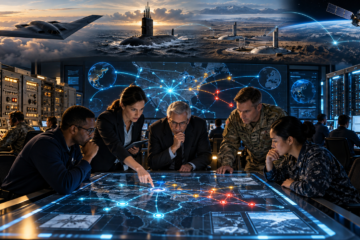

Although the war in Ukraine firmly established the utility of drones in warfare, the relationship between drones and nuclear deterrence is still a largely unsettled topic. Suggesting that they are relevant is unlikely to draw much disagreement, but the exact form that relevance takes is where there may be disagreement. This leads to the following discussion.
Nuclear deterrence is a psychological effect where the perceived costs of taking an action that is undesirable to an adversary outweigh the perceived benefits. During the Cold War, the threat of catastrophic retaliation prevented the Soviet Union and the United States from initiating a nuclear attack against the other.
Historically, this doctrine relied on the survivability of nuclear arsenals in the event of a first strike by the adversary. Secure second-strike and a robust early-warning system were key elements of deterrence credibility. The introduction of drones into this framework in the years ahead creates new dimensions to the deterrence dynamic. Drones may enhance surveillance, improve command and control, and/or potentially deliver nuclear weapons.
Drones offer several advantages that make them attractive in the context of nuclear deterrence. They can provide continuous monitoring of adversary activities, bolstering early warning systems and reducing the risk of surprise attacks. Such a capability could increase strategic stability.
Advanced drones equipped with artificial intelligence (AI) could execute highly accurate first strikes, which could neutralize enemy nuclear assets preemptively. This would likely prove destabilizing.
Fielding drones capable of ensuring the survivability of nuclear forces by serving as mobile and/or concealed platforms could ensure a state maintains a credible second-strike capability. Again, this would likely prove stabilizing.
Drones could also serve as command-and-control platforms in a degraded environment when, for example, space assets are lost early in a conflict. Such a capability could serve as a deterrent to attack.
The integration of artificial intelligence (AI) into drones has significantly expanded their operational capability. AI-enabled drones can autonomously navigate complex environments, identify targets, and execute missions with minimal human intervention. This autonomy is particularly valuable in nuclear scenarios, where rapid decision-making and precision are critical.
Moreover, drones are being developed to carry nuclear payloads, although this remains a controversial and largely theoretical capability. The miniaturization of warheads and improvements in drone propulsion systems make this possibility increasingly plausible. If realized, nuclear-armed drones could offer stealthier and more flexible delivery options compared to traditional ballistic missiles.
Recent conflicts demonstrate the strategic value of drones. In Ukraine, for instance, drones are used extensively for reconnaissance and precision strikes, prompting global powers to accelerate their investment in drone technologies. While these applications are conventional, they underscore the potential for drones to play a role in strategic deterrence.
In the United States, China, and Russia, military doctrines are certain to evolve and incorporate drones into nuclear command-and-control systems. These developments reflect a broader trend toward automation and digitization in defense strategies, raising questions about the future of human oversight in nuclear decisionmaking.
Despite their strategic benefits, drones introduce several risks that could undermine nuclear stability. Autonomous drones conducting reconnaissance near sensitive sites could be misinterpreted as precursors to a nuclear strike, triggering unintended escalation. Increased autonomy in drone operations may reduce human oversight, heightening the risk of accidental or unauthorized use of nuclear weapons. The accessibility and affordability of drone technology could lead to its proliferation among non-nuclear states or rogue actors, complicating global arms control efforts. None of the challenges are guaranteed, but they are possibilities.
To mitigate the risks associated with drones in nuclear deterrence, the following policy measures are recommended. First, nuclear-armed states should develop treaties and agreements that define acceptable uses of drones in strategic scenarios, including restrictions on nuclear payloads. Second, there is a need for information-sharing among nuclear weapons states, designed to reduce misinterpretation of actions and build trust. Third, ensuring that critical decisions involving nuclear weapons remain under human control, even in automated systems, is an important component of any international agreement. Fourth, developing tools to monitor drone deployments and verify compliance with international agreements is also needed.
The potential for drones to enhance surveillance, improve targeting, and support second-strike capabilities makes them valuable assets in maintaining strategic stability. On the other hand, their autonomy, the potential to misinterpret their use, and the proliferation risks of some drones pose a significant challenge. As drone technology continues to evolve, it is imperative that policymakers and military experts work collaboratively to understand its benefits while safeguarding against its dangers. The future of nuclear deterrence stability may be influenced in significant ways by how well or poorly we adapt to drone technologies.
Steve Cimbala is a Senior Fellow at the National Institute for Deterrence Studies. Adam Lowther is the Vice President for Research at NIDS. Views express in this article are the author’s own.


About the Author

Stephen Cimbala
Dr. Stephen Cimbala is Distinguished Professor of Political Science at Penn State university, Brandywine. He is currently a senior fellow with the National Institute for Deterrence Studies.

Adam Lowther
Dr. Adam Lowther is Vice President of Research at the National Institute for Deterrence Studies. Read the full bio here.