
Published: July 20, 2026
NATO’s recent establishment of Baltic Sentry (2025), Eastern Sentry (2025), and Arctic Sentry (2026) reflects more than a response to Russian aggression. Collectively, these operations demonstrate how modern deterrence has evolved to address persistent airspace violations, hybrid warfare, cyber-attacks, sabotage of critical infrastructure, and grey-zone coercion. While these missions are conventional military operations, they derive their strategic credibility from something far more significant, NATO’s integrated nuclear deterrence architecture.
This distinction is critical. NATO’s Sentry operations are not isolated military activities; they are conducted within an alliance whose conventional forces are underwritten by the collective nuclear capabilities of the United States, the United Kingdom, and France. Any adversary contemplating escalation understands that conventional confrontation with NATO carries the inherent risk of nuclear escalation. This integration between conventional and nuclear deterrence has underpinned Euro-Atlantic security for more than seventy years.
For the Indo-Pacific, the lesson is clear. As China rapidly expands its nuclear arsenal, North Korea continues to develop increasingly sophisticated nuclear and missile capabilities, and Russia under Vladimir Putin has revived Cold War-era nuclear coercion, regional allies cannot assume that conventional military cooperation alone will provide credible deterrence. If deterrence is to succeed, it must be built upon a coherent nuclear alliance before a crisis emerges, not after deterrence has already failed.
Conventional Operations Backed by Nuclear Deterrence
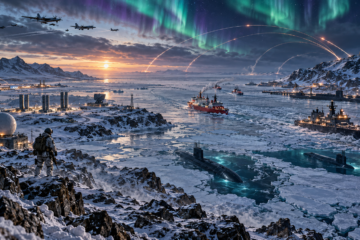
The strategic significance of NATO’s Sentry operations lies not simply in what they do, but in what stands behind them. Baltic Sentry enhances surveillance and protection of undersea communications cables, energy infrastructure, and maritime approaches following repeated acts of sabotage and suspicious activity in the Baltic Sea. Eastern Sentry reinforces NATO’s eastern flank through enhanced air policing, intelligence sharing, and rapid response capabilities in the face of persistent Russian military activity. Arctic Sentry reflects NATO’s growing focus on the High North as Russia and China expand their military presence in an increasingly contested region.
These operations improve situational awareness, interoperability, and alliance readiness. Yet none of them exist in isolation. Their credibility stems from NATO’s integrated command structure, collective defense commitments under Article 5 of the North Atlantic Treaty, shared military planning, and, fundamentally, the Alliance’s nuclear deterrence posture. NATO’s Nuclear Planning Group, alongside the independent nuclear forces of the United Kingdom and France and the United States extended nuclear deterrence commitments, ensures that any conventional confrontation carries strategic consequences far beyond the immediate theater.
This layered approach to deterrence is central to NATO’s success. Conventional operations deter day-to-day coercion, while nuclear deterrence prevents adversaries from believing they can escalate a conventional conflict without unacceptable consequences. The two cannot be separated; together they create a coherent deterrence architecture.
The Indo-Pacific’s Strategic Environment Has Changed
The Indo-Pacific now faces a security environment increasingly defined by nuclear competition. China’s rapid expansion and modernization of its nuclear arsenal is reshaping the regional balance of power. At the same time, Beijing continues to employ sustained grey-zone coercion through military pressure around Taiwan, coercive operations in the South China Sea, cyber campaigns, and increasingly frequent air and maritime incursions directed at neighboring states.
North Korea’s advancing nuclear weapons and ballistic missile programs add another layer of strategic complexity. Pyongyang’s continued weapons development increases the likelihood that any regional crisis could involve nuclear coercion or escalation.
Meanwhile, Russia’s full-scale invasion of Ukraine has demonstrated that nuclear weapons remain central to great-power competition. Throughout the conflict, President Vladimir Putin has repeatedly employed nuclear rhetoric and strategic signaling to deter Western intervention. The assumption that the end of the Cold War marked the end of nuclear coercion has proven false.
For Indo-Pacific allies, this means they are confronting not one, but three nuclear-armed challengers whose strategic interests increasingly overlap. Yet the region’s security architecture remains fragmented.
The Missing Foundation
The United States maintains strong bilateral alliances with Australia, Japan, South Korea, and the Philippines. Regional initiatives such as AUKUS and the Quad have strengthened defense cooperation, technological collaboration, and strategic coordination. These arrangements make important contributions to regional security.
However, they do not constitute an integrated alliance comparable to NATO. They lack common command arrangements, formalized collective defense obligations across the region, institutionalized nuclear consultation mechanisms, and a unified framework for integrating conventional and nuclear deterrence. This matters because conventional military cooperation alone cannot provide fully credible deterrence against nuclear-armed adversaries. NATO’s experience demonstrates that conventional operations derive their strategic weight from the knowledge that they are backed by a credible and integrated nuclear alliance. Without that strategic foundation, conventional activities risk being viewed as isolated demonstrations of resolve rather than components of a comprehensive deterrence posture. The Indo-Pacific is therefore attempting to strengthen conventional deterrence without first establishing the alliance architecture that gives such deterrence its greatest credibility.
Building Deterrence Before Crisis
History consistently demonstrates that alliances formed during conflict rarely prevent that conflict. They manage its consequences instead. Europe’s recent experience illustrates this lesson. Many of NATO’s most significant reforms, including enhanced forward deployments,
strengthened infrastructure protection, expanded readiness, and the establishment of the Sentry operations, were accelerated in response to deteriorating security conditions following Russia’s aggression against Ukraine. They represent adaptation after strategic warning signs became impossible to ignore.
The Indo-Pacific still has an opportunity to act before reaching a comparable point. Rather than waiting for a crisis over Taiwan, the South China Sea, or the Korean Peninsula to force hurried institutional change, regional democracies should begin developing the alliance structures necessary to sustain credible deterrence.
Such an alliance would not require every member to possess nuclear weapons. Instead, it would integrate conventional planning with extended nuclear deterrence, establish mechanisms for strategic consultation, coordinate contingency planning, strengthen interoperability, and ensure that regional conventional operations are supported by a credible nuclear deterrent capable of deterring nuclear-armed adversaries.
Conclusion
NATO’s Baltic Sentry, Eastern Sentry, and Arctic Sentry operations are not simply conventional military initiatives. They are visible expressions of a much deeper strategic reality: conventional deterrence is most credible when backed by an integrated nuclear alliance. Their effectiveness rests not only on ships, aircraft, and surveillance systems, but on the certainty that any attempt to escalate against NATO would confront the Alliance’s collective nuclear deterrent.
The Indo-Pacific faces an increasingly dangerous strategic environment characterized by a rapidly expanding Chinese nuclear arsenal, an emboldened North Korea, and a resurgent Russia that has returned nuclear coercion to the center of international politics. In such an environment, conventional cooperation alone is unlikely to provide sufficient deterrence.
The central lesson from NATO’s Sentry operations is therefore not that the Indo-Pacific should simply replicate these missions. It is that such operations derive their credibility from the nuclear alliance that stands behind them. Waiting to build that alliance until deterrence has failed would repeat the strategic mistakes history has repeatedly exposed. The time to establish an integrated Indo-Pacific nuclear alliance is before a crisis begins, not after conflict has already become unavoidable.
Natalie Treloar is the Australian Company Director of Alpha-India Consultancy, a Senior Fellow at the Indo-Pacific Studies Center (IPSC), a Fellow at the National Institute for Deterrence Studies (NIDS), and a member of the Open Nuclear Network (ONN). Views expressed in this article are the author’s own.



About the Author

Natalie Treloar
Natalie Treloar is the Australian Company Director of Alpha-India Consultancy, a Senior Fellow at the Indo-Pacific Studies Center (IPSC), a Senior Analyst at the National Institute for Deterrence Studies (NIDS), and a member of the Open Nuclear Network.