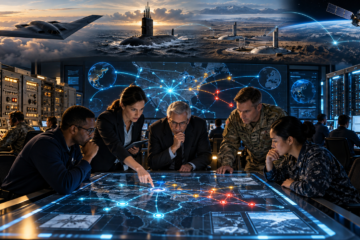

As the United States attempts to better understand the requirements of President Trump’s Golden Dome program, pillar two of the AUKUS agreement has the potential to help solve the “integration problem at massive scale” and provide the needed architecture for collective defense. This initiative would also prevent AUKUS pillar two from “failing in its mission” by enabling the prioritization of advanced technologies at the scale required to achieve Golden Dome missile defense.
Golden Dome is focused on specific missile threats to the American homeland. AUKUS pillar two is designed to reduce the significant lead China has in dual-use emerging technologies. An “extended” Golden Dome approach that produces strong and resilient allies may provide greater strategic deterrence than an America alone approach.
As stronger allies contribute more to collective defense through burden sharing, this can reduce the financial and military burden on the United States. Capable allies can deter aggression and manage local conflicts, promoting regional stability without constant American intervention.
If allies are seen as weak and easily overrun, it may undermine the credibility of alliances and security guarantees, thereby emboldening adversaries. Strong allies often bring advanced technologies and capabilities that enhance joint operations through interoperability and innovation.
Defeating fractional orbital bombardment system (FOBS), intercontinental ballistic missiles (ICBM), submarine-launched ballistic missiles (SLBM), hypersonic glide weapons, and land-attack cruise missile threats is the focus of Golden Dome, which “proposes a multilayered defense network capable of intercepting threats during the boost, midcourse, and terminal stages of missile flight.” Some analysts argue that it is easiest to target these threats in the boost/ascent phase.
Targeting the boost phase can either occur from allied territory, targeting North Korean missiles from South Korea, or the homeland. The boost phase can also be targeted from space. However, targeting from space is not without its own unique set of challenges. Either way, it will not be solved by America without its allies.
Arguably, five-eyes countries (Australia, Canada, New Zealand, United Kingdom, and United States) are already entangled in American nuclear command, control, and communications (NC3). Furthermore, the US operates in coordination with other military forces as part of broader coalition operations. Hence, extending Golden Dome to allies is not only possible, but can further leverage the AUKUS pillar two effort. Moreover, a missile defense system consists of sensors, interceptors, and command-and-control systems that work together to detect, track, and intercept incoming missiles.
These necessary components exist in AUKUS pillar two working groups like the cyber capabilities, artificial intelligence (AI) and autonomy, quantum technologies, undersea capabilities, hypersonics and counter-hypersonics, electronic warfare capabilities, innovation and information sharing, and the deep-space advanced radar capability program (DARC).
AUKUS pillar two leadership should prioritize the development of technologies and supporting systems for an effective extended Golden Dome architecture. America is unlikely to solve the problem in isolation by building a “tightly integrated system of low Earth orbit (LEO) satellites, terrestrial radar stations, directed-energy platforms, and kinetic interceptors” that senses, decides, and neutralizes incoming missiles. The linkages and opportunities for the prioritization of advanced technology development for missile defense can be found in the following summaries.
Cyber capabilities encompass both offensive and defensive operations for missile defense. Offensive cyber tools are used to deter adversaries and disrupt their operations through tactics such as cyber-reconnaissance, communication isolation, targeted strikes, and network intrusions. Defensively, military forces can prioritize robust network protection, active threat disruption, and seamless coordination across units to safeguard critical systems. Cyber operations can enhance intelligence gathering, command and control, and information warfare to shape public perception and the broader information environment. As conflict evolves, training personnel in cyber tactics and integrating machine learning for threat detection and analysis can maintain strategic advantage.
AI and autonomy can transform missile defense and military operations by enhancing efficiency, precision, and decision-making. Autonomous weapon systems are used for reconnaissance, surveillance, and combat missions. AI-driven wargaming platforms simulate real-world combat scenarios to help strategists test tactics and improve readiness. In command and control, AI supports real-time data processing and analysis. AI optimizes logistics by improving resource allocation, supply-chain management, and transportation.
In intelligence and surveillance, AI analyzes vast datasets to detect patterns and identify threats. Additionally, AI monitors threats and predicts future events. Human-machine teaming allows AI systems to collaborate with human operators, combining strengths and minimizing errors.
Quantum technologies transform missile defenses through enhanced security, operational efficiency, and advanced training. In cybersecurity, quantum-resistant cryptography is being developed to protect against the threat quantum computers pose to traditional encryption. Quantum key distribution offers highly secure communication by transmitting encryption keys through quantum channels, making interception nearly impossible.
In military operations, quantum algorithms can optimize logistics, supply chains, and battlefield strategies by analyzing complex data in real time. Quantum computing could process data in real time, enabling missile defense systems to rapidly analyze incoming threats, allowing for quicker decision-making and more effective interception. Additionally, quantum computing could enable highly accurate simulations of complex systems like nuclear reactions and weapon designs.
Undersea capabilities encompass a wide range of offensive and defensive functions that contribute to missile defense. Offensively, submarines and other undersea platforms can strike surface vessels, submarines, and land-based targets. They are also instrumental in inserting special forces into hostile territory for reconnaissance or sabotage missions. Undersea vehicles play a key role in mine warfare, either by laying mines or clearing minefields. On the defensive side, these platforms are vital for anti-submarine warfare, enabling the detection and neutralization of enemy submarines. They also support surveillance and reconnaissance efforts, gathering intelligence on enemy naval movements. Undersea systems help protect vital infrastructure such as pipelines and communication cables and help ensure safe navigation.
Hypersonic weapons and counter-hypersonic systems are vital to missile defense operations. Hypersonic glide weapons and hypersonic cruise missiles are designed to strike targets with exceptional speed, maneuverability, and precision while evading traditional defenses. Counter-hypersonic capabilities include advanced sensors and tracking systems like radar and satellite imaging to detect and monitor hypersonic weapons. Hypersonic interceptors aim to neutralize threats mid-flight, while high-power lasers and microwave weapons can disrupt their guidance systems. Effective command-and-control systems are essential for coordinating these defenses, and soft-kill measures such as cyberattacks offer additional means to interfere with hypersonic weapons.
Electronic warfare is fundamental for gaining military advantages in cross-domain missile defense. Electronic attack includes jamming enemy communications, radar, and navigation systems. It also includes spoofing—sending false signals to enemy forces. Electromagnetic or directed-energy weapons disable or destroy enemy assets. Electronic protection ensures secure communication through encryption and satellite links and employs electronic countermeasures (ECM) to defend against attack. Electronic counter-countermeasures are used to overcome enemy ECM and maintain operational effectiveness. Electronic support can be focused on gathering intelligence through signals interception, using sensors for surveillance and target acquisition, and detecting threats in the electromagnetic spectrum.
In short, under the auspices of AUKUS pillar two, Australia and the United Kingdom can contribute to Golden Dome in ways that many may not be thinking about. As longtime allies with a shared culture, history, and values, working together on Golden Dome just makes sense.
Natalie Treloar is a Senior Analyst at the National Institute for Deterrence Studies (NIDS), a Non-Resident Fellow at the Indo-Pacific Studies Center (IPSC), the Australian Company Director of Alpha-India Consultancy, and a cohost of the NIDS Deterrence Down Under Podcast.


About the Author

Natalie Treloar
Natalie Treloar is the Australian Company Director of Alpha-India Consultancy, a Senior Fellow at the Indo-Pacific Studies Center (IPSC), a Senior Analyst at the National Institute for Deterrence Studies (NIDS), and a member of the Open Nuclear Network.