The Department of War’s (DoW) Maven Smart System (MSS) may not yet constitute a revolution in military affairs (RMA), but it strongly signals one. The MSS is a relatively new system designed as the DoW’s answer to the challenges posed by the transition to multi-domain operations and artificial intelligence (AI) integration. It seeks to enhance the common operating picture through artificial intelligence/machine learning (AI/ML) capabilities—now critical given the complexity and volume of today’s information environment.
Whether the MSS is indicative of an unfolding RMA remains a subject of debate. At a minimum, it represents a significant leap in how modern militaries sense, decide, and act in combat. From a scholarly perspective, RMAs are not defined by single technological breakthroughs but by clusters of innovations that fundamentally transform the conduct of warfare.
They typically involve shifts in doctrine, tactics, organization, culture, and technology. Unlike broader military revolutions, which reshape societies and political systems, RMAs are confined to the military sphere—and they often unfold quietly, only recognized in hindsight.
Several RMAs were identified in the past, providing a framework to anticipate future ones. In The Dynamics of Military Revolutions: 1300–2050, MacGregor Knox and Williamson Murray outline five significant military revolutions in the West since 1618. Each one, they argue, set off a chain of revolutionary changes in military affairs.
These include the emergence of the modern state with its standing armies, the political and social upheavals brought on by the French Revolution, the industrialization of warfare in the 19th century, the era of total war in the 20th century, and the transformative impact of nuclear weapons. If a new RMA is underway, we may not fully recognize it until it has already matured.
The concept of RMA has drawn justified criticism for being abstract, amorphous, and debated to the point of analytical paralysis. After the Gulf War, the DoD’s fixation on identifying the “next RMA” often overshadowed the operational impact of emerging capabilities. Scholars frequently focus on definitional purity rather than assessing real battlefield transformation.
Whether the MSS fits a textbook definition, adopted by the DoW or derived from historical theory, is less important than its functional impact. If an RMA is indeed emerging or approaching, there should be tangible real-world consequences. Otherwise, theory becomes disconnected from practice. In this light, the MSS may serve as a bridge between the long-unfolding information RMA and a new, AI-driven transformation.
The MSS could be indicative of another significant shift in command and control (C2). While the US Army’s command post computing environment (CPCE) already integrates legacy systems into a modular, cloud-capable architecture for multi-domain operations, the MSS pushes these capabilities toward revolutionary real-time situational awareness.
While initially developed to automate drone feed analysis, the MSS has evolved into an AI-powered battlefield intelligence engine. It fuses intelligence, surveillance, and reconnaissance (ISR) data, enables real-time targeting, and supports distributed decision-making. As with the telegraph in the 19th century, the MSS may redefine the military’s relationship with information and time.
Historically, C2 was slow and fragmented. Commanders relied on flags, runners, and direct observation, limited by geography and transmission delay. The Industrial Revolution began to change this. Introduced in 1793, Claude Chappe invented the optical telegraph which allowed faster coordination across long distances. It was Samuel Morse’s electrical telegraph, patented in 1837, that truly revolutionized communication.
AI is reshaping combat just as electricity once did. Electricity transformed communication by creating the foundation for critical innovation, like the internet. The harnessing of electricity for industrial use itself was not an RMA, but it was the essential prerequisite for one. Without it, the revolution in communication that began with the telegraph would not have been possible. AI may not constitute a full RMA on its own, but it is the enabling foundation for one.
During the Crimean War and the American Civil War, the telegraph enabled real-time command for the first time. In the US, President Lincoln relied on the War Department telegraph office to direct Union forces and enforce strategic decisions. Strategic-level C2 became possible, and expectations for real-time situational awareness took hold. The rise of the steam-powered printing press and the expansion of railways accelerated this transformation, making war reporting nearly instantaneous—a precursor to modern information warfare.
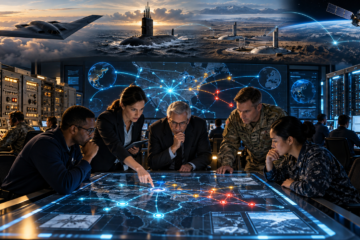
Similarly, Project Maven, initiated in 2017, began as a machine learning initiative to automate drone video analysis. Since then, the MSS has grown to integrate cloud computing, ISR fusion, and targeting. The MSS delivers intelligence to the tactical edge at machine speed on enterprise cloud infrastructure. It processes unfathomable amounts of data in milliseconds— augmenting analysts and automating portions of the workflow.
Just like the electric telegraph centralized control and supported linear commander decisions, the MSS introduces machine learning, machine inference, and adaptive analytics to take command and control. The MSS provides a picture of the theater that is not merely quantitative, but qualitative.
A true RMA requires more than new technology. It demands operational adaptation, organizational restructuring, and doctrinal evolution. The MSS checks many of these boxes. Technologically, the MSS merges AI, edge computing, and cloud infrastructure in a holistic fashion. Operationally, it uses human-machine teaming to accelerate kill chains. Organizationally, it catalyzed the creation of institutions such as the Joint AI Center (JAIC) and the Chief Digital and Artificial Intelligence Office. Doctrinally, it promotes shifts toward algorithmic and mosaic warfare, which are adaptive, data-driven models of conflict.
The MSS could signal a broader shift in military operations, much like the telegraph reshaped communication in the 19th century. By combining intelligence, surveillance, and reconnaissance (ISR) with artificial intelligence at operational speed, the MSS is changing how armed forces interpret the battlespace, make decisions, and coordinate action—all while improving the shared situational picture. Yet without a corresponding cultural shift, even the best tools can fail to yield a true RMA. Whether the Department of War can fully adapt its doctrine and institutions to leverage the MSS remains to be seen.
Lieutenant Colonel Matthew J. Fecteau is an information operations officer working with artificial intelligence. The views expressed in this report are those of the author and do not necessarily reflect the official policy or position of the Department of the Army, the Department of War, or the US Government.



About the Author
Matthew J. Fecteau
Matthew J. Fecteau is a graduate of the Harvard Kennedy School of Government and a veteran of the Iraq War. He specializes in national security issues. Follow him on Twitter @matthewfecteau or email him at matthew.fecteau@gmail.com.